

Sunday April 27th and I am strolling through the gritty, cool and somewhat industrial streets of North East London. My mind lies in the East. Memoirs of ginger, chilli, galangal and coconut, scented memories of shrimp paste, jasmine and lemongrass keep me company and I walk, remembering. But as well as remembering, I look ahead. Look ahead to my next trip North and East, across the river and up to dine with Norman Musa at his London based Malysian Supper Club, Ning London.
Norman Musa is the creator and executive chef for Ning restaurants in Manchester, York and, now, London. Born in Penang, his career as a chef has been nothing but illustrious so far; most notably he was featured on MasterChef Malaysia, was a finalist in the Malaysian National Achievement Awards for his cooking and in Manchester’s Chef & Restaurant of the Year Awards too. For a self-taught and fresh-facedly young chef, not bad. His aim is to make Malaysian food popular in the UK and, going by his food, he stands more than a chance and a half.
Presently, unlike his Manchester and York branches he doesn’t have a permanent restaurant venue in London and so has picked up on the current trend of Pop-Ups, hosting regularly out of cool venues across our capital. I'm not sure I'm allowed to spill the location of this one but, trust me, it was terribly trendy. There, there are no separate tables. Customers dine off a long table, family style and laden with fragrant East Asian treats. On my visit we began with Kerabu Nyonya, a salad of shrimp, bean sprout and curious ginger flower. Next, Otak Otak, pungent fishcakes, spicy and powerful, steamed in a banana leaf. Texturally these are alien to Western style fishcakes. For one thing, potato comes nowhere near it. More like a moulded paste, they were delicious. I could have eaten a platter of them. Next, more than a few curries. My favourite, a Kari Limau Udang, sweet and sour curry with prawns, lime and coconut milk. The Kari Kapitan Ayam with chicken was probably the most familiar to the Western palate; thicker in sauce, more like a North Indian, and rich. I’m probably not alone in being relatively unknowledgeable about Malaysian cuisine – it’s just not something I come across a lot and for this reason I was prepared to be intimidated by the fare and the, potentially more expert, clientele. Not so; Norman and his business partner Andy, explain each course in marvellous detail; for example, describing how the last curry used to be a favourite of captains in the ancient port of Malacca and even giving us tastes of the individual herbs & spices. Dessert was perhaps the most adventurous course for me, exciting in its unfamiliarity. The first was Cendol, a somewhat strange dessert of crushed ice, mixed with coconut milk, palm sugar (akin to a more complex treacle) and pandan (a tropical leaf) flavoured strands of steamed rice, sort of like green noodles. Weird, sort of wonderful. It’s probably the only time I’ll describe a dessert I coined weird, as wonderful. Soak it in. The second dessert? Seri Muka, sweet and stodgy layers of glutinuous rice topped with pandan (yes, that random leaf again) flavoured custard. Doubly weird, but interesting to eat. In summary, everything I ate tasted great. More than that, much of it challenged me. Malaysian food is eaten too little in the UK, no doubt in Europe and America too, and it is great to find such an authentic and interesting source. All very reasonable too at £35. Mr Musa, I’m a fan and I’ll be back. www.normanmusa.com
As sunsets on beachy shore, blood red drops in orange jus, the sunrise in the tequila, so are the shades of beetroot cured salmon. Stunning, stunning and that again. Plated on white and with baby yellow, mustard dill sauce, meals turn into studies of colour and taste. For nor is this recipe style over substance. The beetroot adds a pleasant earthiness to the classic gravlax flavours of salt and citrus. The horseradish, just a hint of the harsh. The gin? Well, I just fancied a tipple. No, not really. I felt the botanicals and juniper would combine well with the lime and dill and, indeed, they do. I hope you enjoy it - everyone I've served it to has! Serve with nice dense brown bread and a mustard & dill sauce (click here for the recipe), or even just alone or with a bit of lemon. Recipe
Ingredients (makes 2 salmon fillets worth - half quantities for one fillet):
1 salmon (Ask your fishmonger to gut it for you and take its two fillets off. I'll tell you how to fillet it though below, in case you buy it whole like I did or get it from a generous fishing friend. It doesn't matter if it is scaled or descaled for gravlax). Use just one fillet too if you want to make less. 60g fresh dill, big stalks discarded and leaves chopped finely 7 tablespoons salt, sea salt best and finely ground 2.5 tablespoons of sugar 3/4 of a lime, diced 300g raw beetroot, grated 2 tablespoons gin 3 tablespoons grated horseradish
Method: 1. Fillet your salmon (skip ahead if you have done this): with a very sharp knife, carefully slice the salmon from tail to the head end about parallel with the gills. BE CAREFUL NOT TO PUT YOUR KNIFE IN TOO DEEP AND PUNCTURE THE GUTS. A sharp knife is key. Reach in and draw out the guts with a tug, discard. Take a teaspoon and scrape along the spine to remove the blood sac. Rinse out with a bit of water. Chop the head off, just behind the gills. Place the fish with the spine side facing you and slice down the spine of the fish, cutting the top fillet off by sliding the knife in and along the top of the spine bones, following the natural line of them and making the cut in smooth, slices. Cut along like this to the tail and remove the top fillet. Turn the fish upside down and repeat with the other fillet. Done. If making just one fillet's worth, cut the fillet in half (so you have two fat short pieces, NOT two long skinny pieces). 2. Take a plate large enough to hold the fillets and lay clingfilm over it. Mix the salt and sugar together. Mix the beetroot with the gin and horseradish. Lay the fillets side by side on the dish. 3. Scatter the salt, sugar mix down the middle of each fillet. Don't scatter it out to the edges - keep it in the middle fat bit, it will spread out to the thinner edges while it cures and if you place it on the edges it will over cure them. 4. Take half of the dill and scatter it all over one of the fillets so that all of the flesh is covered. On top of that place half the grated beetroot. Then scatter the diced lime over it. Make sure the lime doesn't touch the flesh of the fish or it will make it go white as the acid 'burns' it. Keep it on top of the dill and beetroot. Then cover it with the rest of the beetroot, then the dill. 5. Place the 'undilled' fillet on top of the other one, flesh to flesh (skin on the outside) like a salmon fillet sandwich! Wrap the clingfilm up and around the fillets, forming a tight parcel and trying not to get any air in there. Take more clingfilm and wrap it even tighter. Put a second plate on top of the parcel and weigh it down with something. 6. Refrigerate this for 2 days. Expect leakage and drain this off about twice a day and turn it occasionally, twice a day to make sure the brine (formed by the salt and lime) cures the salmon evenly. 7. After 2 days remove the wrapping, separate the fillets and scrape off the beetroot, dill and lime. Slice diagonally in thin slices. Serve!!! 48 hours later... Beautifully sliced Beautiful skin Sliced and beautiful
Upon graduating from University and awaiting my relocation to the bright lights and smoky streets of London, I was regaled with tales of the London dating scene. From what I was told, hoards of eligible single men, straight designer-stubble jawed and suited, were lining the streets waiting for me. I would be whisked off my feet in a blurry of exciting and inventive dates. Boris biking trips around London, parties at snazzy galleries, boating on the Thames. The romantical possibilities I believed to be endless and I was thrilled to arrive. I spent the first few weeks looking my casual best, anticipating those discussed hoards. But as the weeks and months passed, along with my high hopes my high heels shrunk in size as my enthusiasm for looking decent dwindled (though never a kitten heel – the absolute horror). 4 months in, heels were abandoned and lesbian flats adopted in abject defeat. For why should I make an effort, if all you London men can’t either?
And on the 5th day, God said thou shalt take your first date out for drinks. What do you do, where did you study, here drink this white wine spritzer while I tell you that great story again about my job in Finance. Your chat is just bad. I’m all for getting to know each other but really – it’s as if every 20-30 something male in London has read the same poxy guide to dating or downloaded some sort of date template off of Google-schweff. Did you all amass to take a cookie cutter and plan out identical mediocre dates in the hopes of some…success? Would a little imagination go amiss? When did the Disney prince ever sweep his princess off her feet with drinks?
The other night I went to a very special place. I don’t think I’ve said those words since my gap year, though in an entirely different context and it probably wouldn’t be all that appropriate to discuss that right now… This was special in a very different way and, indeed, in a number of them.
We’ll begin with the circumstances; dinner at one of the only five Indian restaurants in the UK to hold a coveted Michelin star, Rasoi in Chelsea, cooked by the most illustrious of hands, those of Chef Vineet Bhatia. Chef Vineet owns 11 restaurants around the world, the Geneva one of which also holds a star, and is the only Indian chef to ever hold 2. Indian food is most commonly known in its inelegant form; big helpings of steaming, spicy curry, split-splattered over acid yellow rice, towering with naans and crisp poppadoms. Nor is this incorrect. Traditionally it is a rustic food; big, warm flavours, tastes and smells of the street, unrefined and moreish. The Indian food served today is an rich amalgamation of hundreds and thousands of years of cultural evolution, influenced by a 5000 year old history of interaction with other societies. The Gupta Dynasty, sometimes called the Golden Age of India, brought in an influx of travellers and trade bringing in new cooking methods and ingredients such as tea and spices. Later invasions from Central Asia brought bloodshed and its own flavours, including saffron. Portugal brought potatoes and chilli pepper, Afghans the naan bread. Each region has its own variance, shaped by the history that lives today on everyday plates of food. Plates similar only in their apparent lack of typical Michelin poise or presentation.
Vineet has changed all this with his spiced empire of Indian cuisine. Fine does not even begin to describe Rasoi’s food. Effortlessly fine (in essence, if not in reality, I hasten to add as I imagine the incredulity of Rasoi’s undoubtedly hard-toiling chefs if reading this). Plated spectacularly, even delicately; Indian food as you have never seen it. All complimented by the elegance of the venue itself – a converted 100 year old Chelsea townhouse where one is admitted into only by chiming doorbell and the walls nod with intricate Indian carvings, heavy with hangings and silks. Service, impeccable; probably the best I’ve had in London. A confident and lush establishment.
Last Wednesday saw me undertake a most unexpected journey. Nor do I refer to the dread commute to central London, nor the erroneous 1 mile trek that Google maps sent me on down Euston Road. Last Wednesday Head Chef Rees Smith at the Golden Arrow restaurant, Pullman Hotel, London St Pancras, took me on a journey to furthest dusky Africa.
I approached this event, organised by international events company Lime & Tonic, with more than a mere frisson of excitement. Has there ever been an event more gloriously titled than the ‘Meat Safari’? In my book, probably not. And when these meats are exotic, unusual ones such as Kangaroo and Crocodile? Ever more and ever more intriguing.
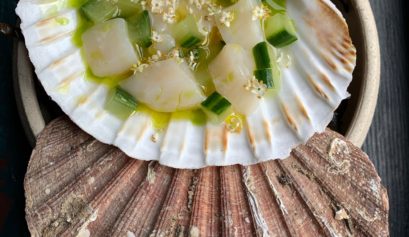
Seated at the Chef’s Table before the open plan kitchen and in the company of Chef Rees talking us through each course, dinner was served. First up; a ceviche of crocodile with lemon and lime, red chilli, coriander leaves and mirin. This defied expectations. I had expected the meat of the Tyrannosauric, hoary old crocodile to be robust, akin to beef or venison, bloody and meaty, fitting its carnivorous diet. The delicate, translucent white flesh, prettily served, completely took me by surprise. Texturally and aesthetically similar to scallops, the crocodile meat tasted somewhat like chicken and with subtle notes perhaps of seafood. Honestly, if this had been given to me without seeing the menu, I would have thought it was a scallop ceviche. Altogether, tasty, classic, elegant flavours: yum. All served with a rather nice Australian Cape Mentelle Margaret River, Semillon Sauvignon.
Scallops and black pudding- a classic combination. Almost as classic (and commonplace) as the classic scallops, peas, bacon combo that so often graces tables, TV screens and Come Dine With Me/Amateur MasterChef shows across the nation, if not world. Not to disparage it- pea, scallop and bacon go perfectly and are delicious, but I am just bored stiff now by it. The culinary equivalent of sitting next to Uncle Jeff at the Christmas dinner table, hearing about his job in IT. I have tried to bring a little bit of life to this combination by mixing it up and bringing in the big risotto guns. It's a good dinner party starter - you can even make the risotto for dinner the night before, reheat it and use it with this. Although of course, that is definitely not how this most carefully composed and thought out recipe came about.....
Only joking - it's great. People will like it. Classic cooking, tasting good, happy days.
Recipe
Ingredients (serves 4):
For the risotto: 2 handfuls Arborio risotto 1 white onion, diced 2 cloves garlic, minced 1 black pudding sausage, roughly chopped butter oil salt/pepper 800ml approx. chicken stock glug white wine, optional lemon juice
12 hand dived scallops (3 each for a starter, 4 each or more for a lunch/main)
Optional: chopped/minced basil, olive oil, lemon juice
Method: 1. For the risotto: Heat some oil in a large pan and saute the onion until soft over medium heat, approx. 2 minutes. Add the garlic and saute for a further minute. Add the risotto rice and a knob of butter and saute for approx. 2 minutes until the risotto rice has gone a little translucent. Make sure to keep it moist with the butter and moving constantly in the pan. 2. Add the white wine (optional) and leave to bubble for 3o seconds or so. Add a glug of the stock and stir continuously until it has all been absorbed. Add another glug of stock and repeat. Repeat this step, continuously stirring to make sure it is creamy, until the risotto rice is soft and cooked through - you might not even need all the stock, judge by the rice. 3. While this is going on, fry off your black pudding in a separate pan until soft and cooked through. 4. When your risotto is finished add your black pudding and stir through. Season with plenty of fresh lemon juice, salt and pepper and stir a big knob of butter through. Put to one side and leave until later. As I say - you can make this earlier and just serve up when you need it with the scallops. 5. For the scallops: put a non-stick frying pan on to heat over high heat. Add a very small knob of butter to grease the pan a little, but otherwise leave it dry, no oil. The pan should be smoking hot. Pat your scallops dry, season with a little salt and place into the pan carefully. Don't cook 16 of them in one pan - you don't want to overcrowd the pan so it loses its heat. If required do in batches or have several pans going. Leave to cook on one side for about 1 minute. Don't be moving it around loads, just leave them alone to cook so that they can get a good crust on. You can occasionally use your fingers to just move it slightly to make sure that it isn't sticking, but don't be stirring them around the pan with a spoon. After about a minute, when the first side has a nice golden crust on it, turn it onto the other side. You can add a spoonful of butter at this point if you want to baste them with. Fry on this side for about another 40 seconds. Season with a little salt and pepper. At this point remove from the pan and place to one side. 6. Plate by spooning 4 little islands of risotto onto the plate and by placing a scallop on top of each. 7. Optional: mix some chopped up basil, a squeeze of lemon juice and some olive oil together and drizzle around the plate - it looks pretty and adds a little zing!
Beautiful scallops
This week I had an old friend over for dinner. This is someone I grew up with, someone whom I explored the trappings of village adolescence with; smoking in the village park, deceiving our parents with stories of sleepovers whilst tearing up the midnight streets of Leeds, more than a little experimentation. We've both now grown up in different ways and it's funny how many changes the years can bring, while at the same time so few. And although they might have snatched our mutual loves of 'wobbly, jackin' house music' (indeed, nowadays all that wobbles with me are my jellies and ever growing lumbars), still our love of blue cheese remains, transcendent of the summers & winters apart.
That evening I cooked this dish: a risotto of pea, bacon & blue cheese with a poached egg. Creamy Gorgonzola with its acidic bite, sweet pea, salty bacon, rich egg. Healthy sprinklings of Parmesan. For me, risotto in hand, wine glass in the other and old childhood friend gabbing away on the sofa, life doesn't get much sweeter.
Recipe
Ingredients (Serves 2):
2 handfuls Arborio risotto rice (approx. 1 per person) butter 6 rashers unsmoked bacon, chopped roughly 2 handfuls of peas, frozen are fine glug of white wine approx. 800ml chicken stock 125g Gorgonzola, chopped into chunks 3 cloves garlic, minced 1 small white onion, diced vegetable oil salt/pepper lemon juice Required: cling film
Method:
1. Heat some oil in a large saucepan on medium heat and gently saute the onion for 3-4 minutes, until soft, not coloured. Add the garlic and saute for another minute. Then add in the risotto rice, a knob of butter and saute, continuously stirring until the risotto rice is lightly fried and translucent, about 2 minutes. Make sure it is always kept wet by the butter and oil and always keep moving it. You don't want it to get any colour or burn. 2. Add in a good glug of white wine and leave to bubble so that the alcohol burns off. Stir. Add in a glug of the chicken stock and stir continuously for a minute or so, until the stock has all been absorbed. Add another glug of stock and repeat. Repeat this continuously, always stirring - it is this that gives risotto its desired creaminess. Do this until the risotto rice is soft, cooked through but still with a tiny bit of bite. At this point stop adding the stock - you don't want it to be too liquidy. You might not need to use all the stock -you might even need more - it isn't an exact art, judge when it is done by the rice. 3. While you are doing this, fry off your bacon in a separate pan until crispy. Set a pan of water on to boil. 4. For the poached eggs: Take a large square of cling film and lay over a teacup. Poke the clingfilm a little bit inside the cup so there is a bit of a dip, where you can crack an egg into. Oil the clingfilm with some vegetable oil. Crack an egg into it. Gather the sides of the cling film up, squeezing out any air and twist to make a little egg parcel!! Do this for all your eggs. 3 minutes before your risotto is ready, place into boiling water and poach like that for 3 minutes. By doing it this way you can cook all your eggs at the same time, they are a consistent shape and cook the same way every time. It is foolproof. 5. When the risotto rice is nearly done, tip in the bacon and peas and stir in to combine. Scrape in all the bacon oil and scraps & swirl the pan with stock to wash out all that lovely pork, salty flavour and tip in. 6. Once the rice is cooked, turn the heat off, stir in a large knob of butter to add final richness and shine, gently fold in your Gorgonzola and season with salt (you won't need much - the bacon and cheese are salty enough), pepper and fresh lemon juice. Plate. Remove your eggs from the clingfilm. Place on top of your risotto, season with a little bit of salt. Grate Parmesan over the whole thing. Serve.
Yum
Ahh brunch; meal of Kings, Sunday Layabouts and, in the case of my source for this recipe, Presidents. French Presidents to be exact, President François Hollande to be more exact. Oeuf Poche Meurette is a dignified and staunch classic French dish. Translating as 'eggs poached in red wine' it is the dreamy concoction of butter sauteed mushrooms, crisp lardons of bacon, caramelised shallots, fried country bread, even more butter and, yes, eggs poached in red wine with a red wine reduction. Plus more butter. Oh and did I forget, more butter? Ahh, on slicing into the egg rich, orange yolk bursts out, running into burgundy deep sauce, soaking into buttery, chewy country loaf. Salty bacon dancing in, earthy intense mushrooms, sweet, sweet shallots. More than enough to make me quiver to my very bones. Not even because I'm dying of coronary failure either. Hopefully you'll like it too. Because really; what could be more perfect? Really. The provenance of this dish's appearance on my plate came from a most exciting encounter. For the other week's #InGoodTaste @Z1Radio show we were invited along to Le Gavroche in Mayfair, London to interview legendary chef and (sometimes) cheery face of Master Chef Professionals, Michel Roux Jr. Incidentally, writing this oh-so-casually - god, I'm a name dropping twat - portrays a cool that was oh-so-certainly not felt. A dribbling mess, I'm surprised his PA even let me through the entrance - the man has been my idol since I was a child. Check out the barely suppressed hysteria in my voice on the clip, quite funny in hindsight. ANYWAY, it was Chef Michel who told us about this dish and of how he used to cook it for President Francois - who used to eat it for breakfast! Nor was I about to ignore his advice - I stomped off immediately to Balham market to pick up the ingredients and wa la - eggy, wine'y wonderfulness served on a plate. Thanks, Chef. What a babe. In a bid to be more civilised, more British less French *ho ho*, I am converting it to a brunch dish, as oppose to breakfast. Eat it later in the day if you like, just do eat it - it's a dream. And if you want to listen to the show follow this link - I cook this recipe in the second half. http://www.mixcloud.com/InGoodTaste/ingoodtaste-meets-michel-roux-jr/FYI - for more epic brunch dishes check out #brunchathon on Twitter. Me and a few other lovely food writers are doing a little experiment where we all blog along together on a different theme every week! Recipe
Ingredients (Serves 4):
1 bottle of robust red wine, a burgundy or something similar. Buy a good one - for this recipe it makes a difference 500ml chicken or veal stock 8 free range eggs 1 pack of good butter, I like salted 250 grams of smoked bacon, cut into thick lardons 250g of mushrooms, roughly chopped 2 cloves garlic, minced Lemon juice 16 shallots, peeled (use onion quarters if you like too) 1 onion, roughly chopped 8 thick slices of good quality country bread, or brioche salt & pepper tablespoon of sugar (optional) With this dish I really feel that buying quality makes a difference. It's so simple, the flavours are so pure that quality really does speak. I'm not asking you to spend a fortune, please don't, I didn't, but pop along to your local farmers market and buy local. The butter we bought was churned only 4 days before, the bacon was from a farm in Kent, the eggs were from apple orchard hens and the bread was from a bakery in North London. Everything was great, Balham market did us proud and consequently so did the brunch!
LOOK AT THIS BUTTER!!! Method:
1. Pour your wine into a saucepan and bring to a boil. Crack your eggs into cups (so that they're ready to poach). Swirl your wine into a whirlpool and tip one egg into the centre- the whirlpool stops the egg flying apart and separating in the liquid. Poach for 3 minutes. Remove with a slotted spoon and plunge into ice-water to stop it cooking further. Repeat with the rest of the eggs. 2. Sieve your wine to remove the eggy bits and put back on the heat. Add your onion and a few pepper corns and turn the heat up. Reduce to about half the size - around 20-25 minutes. Then remove the onion by sieving, add the stock and reduce again to about a half/third of its size. Finish off with a good old knob of butter. It should be thick and glossy when finished. If it isn't thickening you can add a spoonful of flour in with the butter too to thicken it. It should be thick enough to coat the back of a spoon. 3. While your sauce is cooking, prepare your sides - you can do 3-5 simultaneously. Heat a pan with some butter melted in it (2 tablespoons, but who's counting). Add your garlic and saute for 1 minute until it's nice and fragrant. Throw in your mushrooms and saute, stirring for about 5 minutes until the mushrooms are soft and cooked. They'll go through a stage where they release a load of juices, then they'll absorb them back in and soon after they'll be finished. Season with salt, a little bit of pepper and a generous squeeze of fresh lemon juice. Set to one side. 4. In a frying pan heat more butter. Add your shallots and caramelise for about 10-15 minutes until they are golden brown and beautifully soft throughout. You can chuck in a tablespoon of sugar around 6 minutes in to encourage the shallots to caramelise, but this is optional. I like doing it though. 5. Heat some oil in a pan and fry off your bacon lardons until crisp. 6. When your sauce is ready, prepare your bread. Take a pan and heat, guess what, more butter. When melted and bubbling add your thick slices of beautiful bread and fry until golden brown on each side. Feel free to chuck in the bacony oil too - it adds extra flavour. 7. Reheat your eggs by immersing them in boiling water for about 90 seconds. Reheat the rest of your sides and sauce too if needed. 8. Plate up by placing your poached eggs onto your bread - add a few grains of salt on top of the eggs too to season. Scatter the mushrooms, shallots and bacon around the plate. Spoon over that lovely red wine reduction and serve immediately. Guzzle with vigor.
beautiful orchard eggs bubble away, mister sauce poaching egg human sacrifice? le oignon butter and sugar for caramelising the shallots How can you remain impassive at this photo? Pure joy. Frying country bread Making the glaze Tonnes of pans Plating up Yum
Every year I am in charge of the Christmas starter. Main course, be it Goose or (God, forbid) Turkey, is still very firmly in the domain of Mother. Indeed it will be a significant and poignant day when I take over the realms of the Christmas Day Lunch - a sort of coming of age moment.
Anyway - in my parents retirement we have moved to Kent and are a bare 20 miles from France! The potential for many booze and food runs to France is there and realised. This year we went over and got a giant slab of yummy duck foie gras and it was my lucky job to turn it into a delicious dish! I love the texture of foie gras when it is seared - molten, oozing, achingly soft on the inside, texture and seared bite on the outside. Salt, fat, mmm. I wanted something acidic to cut through the fat of it to go with it too and something fruity for a bit of balancing sweetness - hence the pickled fruits. I took the inspiration for the pickled blackberries from the St John restaurant in Chinatown where I had eaten them the week before - I think it works in this context fabulously. Delicious.
The fruits are all individually pickled in complimentary brines. You can do these the day before and then just dish them up on the day.
Recipe
Ingredients (serves 4):
600g whole lobe of fresh foie gras salt
100g blackberries 100g cherries 100g radishes 2 cups white wine vinegar 6 tablespoons sugar 3 tablespoons salt 1 cup balsamic vinegar zest of one lime 1 cinnamon stick
Method:
1. For the pickled radishes: Put a cup of white wine vinegar, a cup of water, 2 tablespoons of sugar and a tablespoon of salt into a pan and bring to the boiling point. Take off the heat and pour over the radishes. Leave to infuse for 4+ hours. 2. For the pickled cherries: Put a cup of balsamic vinegar, 2 tablespoons of sugar and a tablespoon of salt into a pan and bring to the boiling point. Take off the heat and pour over the cherries and add the cinnamon. Leave to infuse for 4+ hours. 3. For the pickled blackberries: Put a cup of white wine vinegar, a cup of water, 2 tablespoons of sugar and a tablespoon of salt into a pan and bring to the boiling point. Take off the heat, add the lime zest and pour over the blackberries. Leave to infuse for 4+ hours. 4. For the foie gras: keep refrigerated until just before ready. Remove and slice into 3/4 inch slices. Heat a frying pan over medium/high heat for 1 minute or so until nice and hot. Don't add any oil - as soon as the foie gras goes in it will start to melt (it essentially is just pure fat) - oil is an unnecessary addition. When the pan is hot add a slice of the foie gras carefully to the pan using a pallet knife - be carefully, it falls apart easily. Saute on each side for about 2 minutes. It should be browned on each side with a nice crust, but still rare on the inside. Once seared on both sides put onto kitchen paper to soak up the salt. Season with a little salt. 5. Serve with triangles of toast and the pickled fruit and vegetables. Enjoy.
Radishes Sliced and into the pickle Pickling brine for the cherries Cherries pickling Blackberries Bit of lime for the brine Foie gras Sauté plating time ta daaaa
Everyone says that they have the best brownie recipe. Literally everyone in the world. However, the fact is; they lie. Barefacedly. Because, in fact, I have the best brownie recipe in the world. I don't pretend any superiority with this statement. The fact it - the credit is not due to me, but to Nigella, my friend Katy and to Chance itself. Katy was cooking Nigella's acclaimed Snow Flecked Brownies, commonly considered the second best brownies in the world, for some friends one evening. On putting in the salt for them, she slipped. Slipped and dropped a whole heaped teaspoon's worth in of chunky, Maldon sea rock salt. Disastrous. But not so. We discovered that actually - they were amazing. Deep, intense, richer-than-Croesus chocolate, melting, melting onto your tongue, suddenly juxtaposed with a sharp zing of intense salt as a flake flicks. A veritable orgasm.
Doubters, go on and hate. But have a mouthful and you'll soon be singing PRAISE to the Nigella Fortune salty gods. I'd like to think I'd get a mention too.
PS- make sure to use really good quality chocolate and it has to be good chunky sea salt too.
Recipe
Ingredients (makes about 16 brownies):
370g unsalted butter 370g good quality dark chocolate 6 eggs 340 caster sugar 1 tbsp vanilla extract 210g plain flour 1 heaped teaspoon of Maldon sea salt (or good quality sea salt flakes) 250g good quality white chocolate, chopped
Method:
1. Preheat your oven to 180 Celsius and line the sides and base of a 13 by 9 by 2-inch baking tin with baking paper. 2. Set up a bain marie. This is a saucepan with a couple of inches of water boiling in it with a heat proof bowl set over the top. It allows you to melt things not using direct, too fierce heat. Put your butter and dark chocolate into the bowl and melt over low heat. 3. Beat the eggs, sugar and vanilla together in a separate bowl until smooth. 4. Once your chocolate and butter has melted and cooled a little add gradually to the egg, sugar mixture and beat together. Fold in the flour and salt and then stir in the white chocolate chunks. 5. Stir to combine and pour into the baking tin. Bake for around 25 minutes, certainly no longer. When they are ready the top is a slightly paler brown 'speckle' and the middle should be dark, dense, gooey and almost raw. Keep checking on it - if they look ready before 25 minutes is reached, after about 18, take them out. Different ovens cook faster and the worst thing you can do with these brownies is over cook them! They turn dry in a matter of minutes and they'll keep cooking in the pan anyway, even out of the oven, so don't be afraid of them being underdone - you want them gooey! 6. Leave to cool for a while and serve while still warm, cut up into squares. Or you can leave to cool to room temperature. Either works, either is delicious.
Thanks Nigella, thank you Katy, thank you Fortuna.
|